
Cut SaaS Customer Acquisition Payback Under 12 Months for Growth Teams
Cut SaaS Customer Acquisition Payback Under 12 Months for Growth Teams
The fastest path to sustainable growth in 2026 is a three-engine acquisition system: compounding organic channels, scalable paid capture, and human-driven outbound and partnerships, run together rather than in isolation. Anchor every channel decision to two guardrails: an LTV:CAC ratio of at least 3:1, ideally 4:1 to 7:1, and a CAC payback period under 12 months. The playbooks and benchmarks below show exactly how to hit both.
TL;DR:
- Median SaaS CAC has increased by 40% to 60% since 2023, with self-serve B2B averaging around $702 and sales-led enterprise exceeding $11,000 per account.
- Companies should segment CAC by channel and cohort to accurately measure payback and avoid over-investing in underperforming channels before proven profitability.
- The three-engine acquisition model recommends focusing on organic growth early, paid campaigns for pipeline gaps, and human-driven outbound for larger, high-value accounts, adapted to company stage.
- Channels must hit payback targets consecutively for two months before launching or scaling additional paid efforts to prevent wasted spend and reporting confusion.
- Strong onboarding that aligns expectations and a measurement infrastructure tracking activation, churn, and expansion are essential to protect unit economics during growth.
Table of Contents
- What Are the Key SaaS Customer Acquisition Metrics for 2026?
- The Three-Engine Model: Staging Acquisition by Company Phase
- Which Channel Playbooks Actually Work for SaaS Growth?
- How Do You Build a Repeatable SaaS Acquisition Engine?
- How Do You Protect Unit Economics as You Scale?
- SaaSLaunch’s Four-Stage System in Practice
- What Are the Biggest SaaS Customer Acquisition Challenges?
- Why Does Sales and Marketing Alignment Matter for Acquisition?
- How Does Onboarding Affect Acquisition and Retention?
- Author Perspective: Prioritization and Common Founder Mistakes to Avoid
- How Saaslaunch Turns This Playbook Into Results
- Sources
What Are the Key SaaS Customer Acquisition Metrics for 2026?
You cannot fix what you do not measure, and most SaaS teams measure customer acquisition cost wrong. CAC is total sales and marketing spend divided by new customers acquired in a given period, but the number only means something when you segment it by channel, cohort, and motion instead of blending everything into one misleading average.
The core formulas every growth leader needs:
- CAC = (Total Sales + Marketing Spend) / New Customers Acquired
- LTV = Average Revenue Per Account × Gross Margin % / Churn Rate
- CAC Payback Period = CAC / (Monthly Recurring Revenue per Customer × Gross Margin %)
- New-ARR Ratio = Total Acquisition Spend / Net New ARR Added
Segmenting CAC matters because a blended number hides where money actually works. A company spending heavily on brand paid search might show a healthy average CAC while its outbound motion quietly loses money on every deal. Break CAC out by channel, by customer segment, and by acquisition cohort month over month, then compare each slice against payback targets rather than against the company-wide average.
2026 Benchmark Snapshot: Median SaaS CAC has climbed 40% to 60% since 2023, with typical self-serve B2B CAC landing around $702 and enterprise sales-led CAC exceeding $11,000 per account. The new CAC ratio, meaning dollars spent to generate $1 of new ARR, now averages roughly $2.00 industry-wide.
Payback targets should shift with company stage. Early-stage companies burning venture capital can tolerate 12 to 18 month paybacks if the LTV:CAC ratio stays above 3:1. Capital-efficient or bootstrapped companies should push for payback under six months, because they lack the runway to wait out a slow-recovering channel. Whatever your target, the goal is the same: know your number by channel, not just in aggregate, before you decide where to spend the next dollar.
The Three-Engine Model: Staging Acquisition by Company Phase
Most SaaS companies over-invest in one channel too early and starve the others, which is exactly backward. The three-engine model treats acquisition as three distinct systems that mature at different speeds and serve different purposes.
Engine one, compounding organic, covers SEO, content, community, and referrals. It is slow to build and cheap to run once it compounds, which makes it the backbone of long-term CAC reduction. Engine two, scalable paid capture, covers Google Ads, Meta, and LinkedIn. It is fast to turn on and fast to turn off, useful for filling pipeline gaps while organic matures. Engine three, human-driven motions, covers outbound, partnerships, and enterprise sales. It costs more per deal but unlocks larger accounts that self-serve channels rarely reach.
Allocation should track company phase, not founder preference:
- Pre-product-market-fit: Spend almost entirely on human-driven motions. Founder-led outbound and design partner outreach generate the qualitative signal you need before any channel deserves paid scale.
- Repeatable stage: Once 10 to 20 customers convert through a consistent process, split spend roughly 40% paid capture, 35% organic content, 25% human-driven expansion into adjacent segments.
- Scale stage: Shift weight toward organic as it compounds, usually 45% organic, 30% paid, 25% human-driven, while adding partnerships as a fourth lever for enterprise accounts.
Before adding a new channel, run it through a short checklist: does the current engine already produce payback under your target threshold, do you have the operational capacity to service a new motion without breaking the existing one, and can you attribute results cleanly enough to know if it worked within 90 days. If any answer is no, fix that first.
Pro Tip: Never launch a second paid channel until the first one hits its payback target for two consecutive months. Parallel underperforming channels just double your reporting confusion without doubling your pipeline.
Building this staged approach from scratch takes real planning discipline. A structured GTM strategy built before you spend a dollar on ads prevents the common mistake of scaling a channel that was never actually profitable.
Which Channel Playbooks Actually Work for SaaS Growth?
Every channel has its own economics, timeline, and failure mode. Here is what works in practice across the six motions that matter most in 2026.
Product-led growth (PLG) works when activation is treated as the real acquisition milestone, not the signup. A customer is not “acquired” until they hit your product’s core value moment, so design your onboarding flow to push toward that event within the first session.
SEO and content compound slowly but become the cheapest channel over a two to three year horizon. Build topical authority around your category’s core problems, publish on a consistent cadence (weekly for competitive categories, biweekly for niche ones), and prioritize commercial-intent keywords before top-of-funnel awareness content.

Paid search and paid social demand structured testing, not a single “set it and forget it” campaign. Run at least three creative variants per audience segment, refresh creative every two to three weeks to avoid fatigue, and expect CPC ranges that vary widely by category, so benchmark against your own historical data rather than industry averages. A dedicated Google Ads system built around high-intent keywords typically outperforms broad-match campaigns aimed at awareness traffic.
Outbound built on signal detection rather than cold lists is the biggest shift in 2026 tactics. Layer three signal types: product usage thresholds (a free user hitting a usage cap), external intent (funding announcements, tech-stack changes), and firmographic fit. Feed those signals into AI-assisted message drafting with mandatory human approval before anything sends.
Partnerships built through integrations generate deals that close faster and churn less, because a partner’s endorsement pre-qualifies fit. Prioritize partners whose customer base overlaps yours but whose product does not compete.
Referral programs consistently rank among the cheapest acquisition channels available, often producing customers at a fraction of blended paid CAC. Design incentives around mutual benefit (both referrer and referee get value) rather than one-sided rewards, and trigger the ask at a moment of proven product value, not immediately after signup.
How Do You Build a Repeatable SaaS Acquisition Engine?
A repeatable engine is not one big launch. It is a sequence you run in order, without skipping steps because a shortcut looks tempting.
- Define your ideal customer profile with real data, not guesses. Pull firmographic and usage data from your best existing accounts (highest LTV, lowest churn, fastest activation) and look for shared traits in company size, tech stack, and buying trigger. Interview five to ten of those customers directly about why they bought.
- Map funnel stages to specific motions. Awareness maps to content and paid social, consideration maps to comparison content and case studies, activation maps to onboarding flows, and expansion maps to lifecycle email and customer success outreach. Assign one measurable metric to each stage.
- Design experiments with real statistical guardrails. Set a minimum sample size before you judge a test (generally at least 100 conversions per variant for paid campaigns), define your success signal in advance, and commit to a decision date rather than checking results daily and reacting to noise.
- Set budget rules tied to payback, not conviction. Start every new channel with a fixed test budget capped at what you can afford to lose, and only scale spend once payback lands under your target threshold for two consecutive measurement periods.
- Build your experiment roadmap on a rolling 90-day cycle, testing one major variable per channel at a time so you know what actually caused the result.
Pro Tip: Write your ICP definition down and share it with sales before you write a single piece of outbound copy. Misaligned targeting is the single most common reason signal-based outbound underperforms.
Teams that skip the ICP step tend to build funnels for “anyone who might buy,” which quietly inflates CAC across every channel at once. A tool like a structured growth-leak audit can catch this misalignment before it burns another quarter of ad spend.
How Do You Protect Unit Economics as You Scale?
Growth that breaks your unit economics is not growth, it is a countdown. Protecting CAC and LTV requires instrumentation most teams build too late.
Cohort analysis should track three things for every monthly signup group: activation rate within the first week, early churn in month one and two, and expansion revenue by month six. A cohort with strong activation but rising early churn signals an onboarding problem, not an acquisition problem, and no amount of new lead volume fixes that.
- Track activation rate weekly, not monthly, so you catch onboarding breakage fast.
- Watch early churn (days 0 to 60) separately from steady-state churn, since they have different causes.
- Measure expansion revenue per cohort to see whether LTV assumptions from your model actually hold up in practice.
Attribution has gotten harder as third-party cookies fade, which means server-side tracking and first-party signal collection are no longer optional infrastructure. Capture UTM data at the point of signup, store it against the customer record permanently, and build a lightweight data warehouse view that ties acquisition source to downstream revenue, not just to signup counts.
Benchmark to remember: Measurement maturity is now the key differentiator between growth teams. Teams running server-side, first-party attribution keep CAC flat or falling year over year, while teams relying on default platform attribution see CAC climb as ad platforms lose signal.
Decide scale versus optimize with a simple rule: if payback is under target and LTV:CAC exceeds 3:1, add budget. If either metric is off target, stop adding spend and fix activation or targeting first. Scaling a broken funnel just multiplies the break.
SaaSLaunch’s Four-Stage System in Practice
Saaslaunch built its four-stage system, offer optimization, funnel creation, targeted messaging, and multi-channel deployment, specifically to compress the playbook above into a repeatable engagement. Each stage maps directly to the model covered here: offer work fixes conversion economics before spend scales, funnel creation aligns activation with acquisition, messaging testing finds message-market fit across paid and outbound, and deployment runs the three-engine allocation across channels simultaneously.
Clients typically see measurable ARR lift and shortened payback periods within a 12-week engagement window. The Acrely case study shows this system taking a company from limited visibility to $1.46 million in ARR, and the broader case study archive documents similar outcomes across different SaaS categories and stages.
What Are the Biggest SaaS Customer Acquisition Challenges?
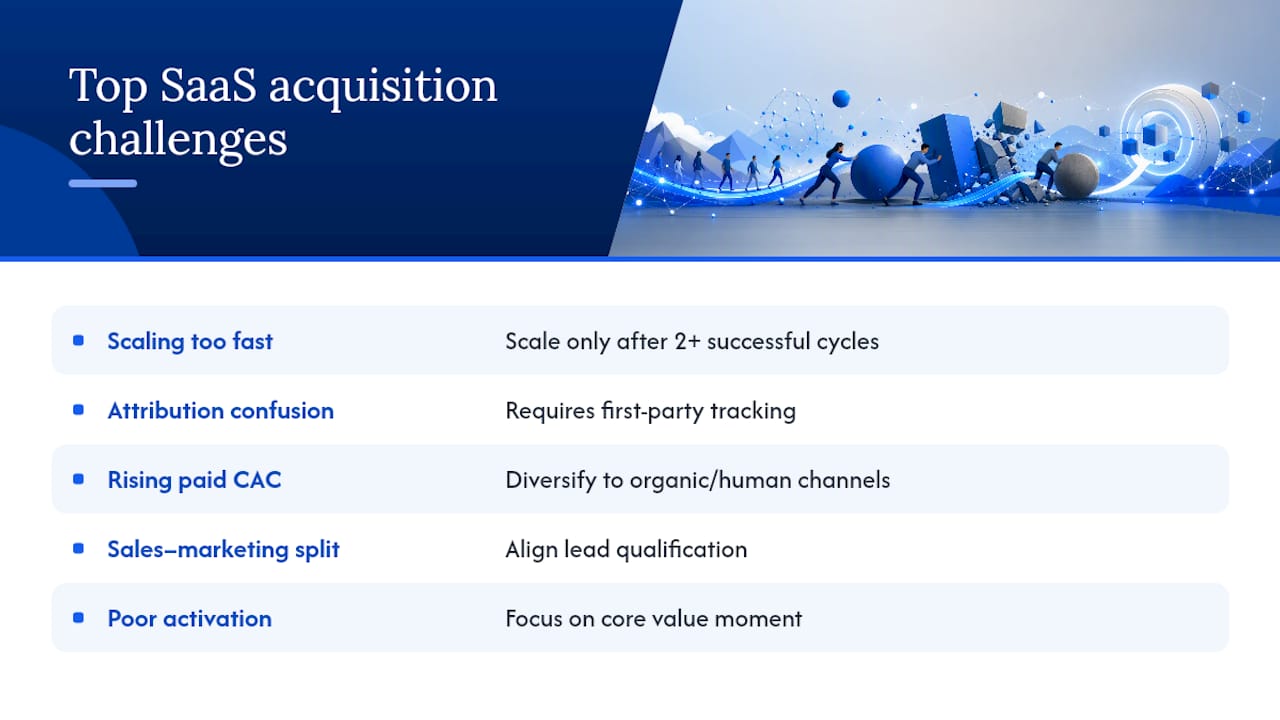
The most common failure is scaling a channel before it is repeatable. Founders see one good week of outbound replies or one viral content piece and pour budget into it before confirming the result holds across a second and third cycle. Confirm repeatability across at least two measurement cycles before scaling spend.
Attribution confusion ranks second. Multi-touch buyer journeys make it easy to credit the wrong channel for a conversion, especially when paid search captures demand that content or referrals actually generated. Fixing this requires the first-party tracking infrastructure covered above, not a better dashboard.
Rising CAC across paid channels is a structural trend, not a temporary blip, driven by increased competition for the same keywords and ad inventory. The answer is not to abandon paid, but to diversify spend toward organic and human-driven engines that are not subject to the same auction-driven inflation.
Sales and marketing misalignment creates a fourth recurring problem: marketing generates leads that sales considers unqualified, or sales closes deals marketing cannot replicate at scale. This gets its own dedicated fix in the next section, because it deserves one.
Underinvesting in activation rounds out the list. Teams treat signup as the finish line, when a customer that never reaches your product’s core value moment was never really acquired at all, just captured. Every challenge above traces back to one root cause: measuring the wrong thing, or measuring the right thing too late to act on it.
Why Does Sales and Marketing Alignment Matter for Acquisition?
Marketing and sales disagreement over lead quality is one of the most expensive, least visible costs in SaaS growth. When marketing optimizes for lead volume and sales optimizes for close rate, the two teams end up pulling in opposite directions without anyone noticing until quarterly numbers come in short.
The fix starts with a shared definition of a qualified lead, written down and agreed by both teams before any campaign launches. That definition should reference the same firmographic and behavioral signals used in your ICP work, not separate criteria each team invented independently. Marketing then hands leads to sales with context: what content they engaged with, what triggered outreach, and what problem they seem to have, rather than a bare contact record.
Service level agreements between the two teams work well in practice: marketing commits to a lead volume and quality bar, sales commits to a response time and follow-up cadence, and both teams review the same pipeline dashboard weekly. When outbound is signal-based, as covered earlier, alignment gets easier by default, because sales is working leads that already showed a real trigger rather than cold names from a purchased list.
A connected sales enablement system that gives reps direct visibility into what marketing content and campaigns produced each lead shortens this alignment gap considerably. Companies that review win rates by lead source monthly, not quarterly, catch misalignment while it is still a small problem instead of a lost quarter.
How Does Onboarding Affect Acquisition and Retention?
Acquisition does not end at signup, it ends at activation, and the gap between those two moments is where most SaaS companies quietly lose the customers they just paid to win. A customer who signs up but never reaches your product’s core value moment counts as a cost with no return, regardless of how efficient the channel that brought them in looked on a dashboard.
Strong onboarding design starts before signup, with messaging that sets accurate expectations about what the product does and how fast value appears. Mismatched expectations, created by acquisition messaging promising more than the product delivers, are a leading cause of early churn that no onboarding flow can fix after the fact.
Once a customer is in the product, the onboarding sequence should be built around a single activation milestone, not a checklist of feature tours. Measure time-to-activation as rigorously as you measure CAC, because a slow path to value quietly inflates your effective acquisition cost even when the raw CAC number looks fine.
Retention and acquisition share the same infrastructure in a well-run SaaS company: the same cohort data that reveals a churn problem also reveals which acquisition channels bring in customers who actually stick. Channels that produce high signup volume but low activation rates are not cheap, they are deferred expensive, and only cohort-level tracking catches that before it shows up in a quarterly churn report.
Author Perspective: Prioritization and Common Founder Mistakes to Avoid
The sequence matters more than the tactics: product-market fit first, activation second, then one or two channels proven repeatable, then measurement infrastructure, only then scale. Founders consistently skip step three and jump straight to scale, chasing a channel that worked once instead of confirming it works twice.
The costliest mistake is not picking the wrong channel. It is scaling a channel before payback is proven, then blaming the channel when the math falls apart at volume. Outsourcing to an agency makes sense the moment you have proven demand but lack the operational bandwidth to run multi-channel testing rigorously in-house.
— Mahdy
How Saaslaunch Turns This Playbook Into Results
Saaslaunch exists for founders who read a playbook like this one and want someone else to run the testing, the segmentation, and the channel math while they run the company. Where a DIY approach means months of trial and error across paid, outbound, and content before you find repeatable payback, Saaslaunch compresses that discovery window into a structured 12-week engagement built around the same offer optimization, funnel creation, and multi-channel deployment covered above.
A typical engagement starts with offer and message-market fit work, moves into funnel construction and paid or outbound deployment, and closes with measurement infrastructure so you keep the gains after the engagement ends. The goal every time is the same: add meaningful ARR without guessing which channel deserves the next dollar. If you are ready to see what a structured system does for your acquisition numbers, start with Saaslaunch’s paid acquisition system or explore the core service overview to find the right starting point for your stage.
Sources
The Stripe CAC guide covers the core formulas and LTV:CAC benchmarks used throughout this playbook and works well as a quick reference when calculating your own numbers. The SaaSUltra 2026 benchmark report supplies the CAC growth and new-ARR ratio figures cited above, useful for checking your own numbers against current market medians. The DeepResearch Ninja acquisition playbook is the source for the three-engine model and referral-channel economics, worth reading in full for deeper channel sequencing detail. The SalesClaw AI-first lead generation playbook expands on signal-based outbound mechanics for teams building that motion from scratch.
- The SaaS Customer Acquisition Playbook | DeepResearch Ninja
- SaaS Customer Acquisition Cost (CAC) Statistics 2026: Benchmarks Every Founder Needs to Know
- SaaS Lead Generation in 2026: The AI-First Playbook